Practical guidance for living healthier, aging well, and becoming more of who you want to be.


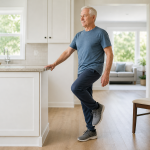
Falls are the leading cause of injury among adults 65 and older — but they’re also one of the most preventable health risks we face as we age. The good news, backed by some of the largest research reviews on the topic, is that a specific type of exercise can meaningfully lower your risk. Not walking. Not general fitness classes. Balance training.
Here’s what the research actually shows, and a simple routine you can start this week.
What the Research Says
A major Cochrane review — one of the most rigorous forms of medical evidence — analyzed 108 randomized controlled trials involving more than 23,000 older adults living independently in the community. The findings were clear:
- Exercise programs reduced the total number of falls by about 23%.
- The number of people who experienced at least one fall dropped by about 15%.
- Programs built mainly around balance and functional exercises had the strongest, most consistent evidence for reducing falls.
- Programs combining balance work with strength (resistance) training also helped, though the evidence there was slightly less certain.
- Interestingly, resistance training alone (without a balance component), walking programs, and dance programs did not show strong evidence of reducing falls on their own — balance is the key ingredient.
The takeaway: if you only have time for one type of exercise to protect your independence as you age, balance training earns its place first.
The Routine: 5 Exercises, 15–20 Minutes, No Gym Required
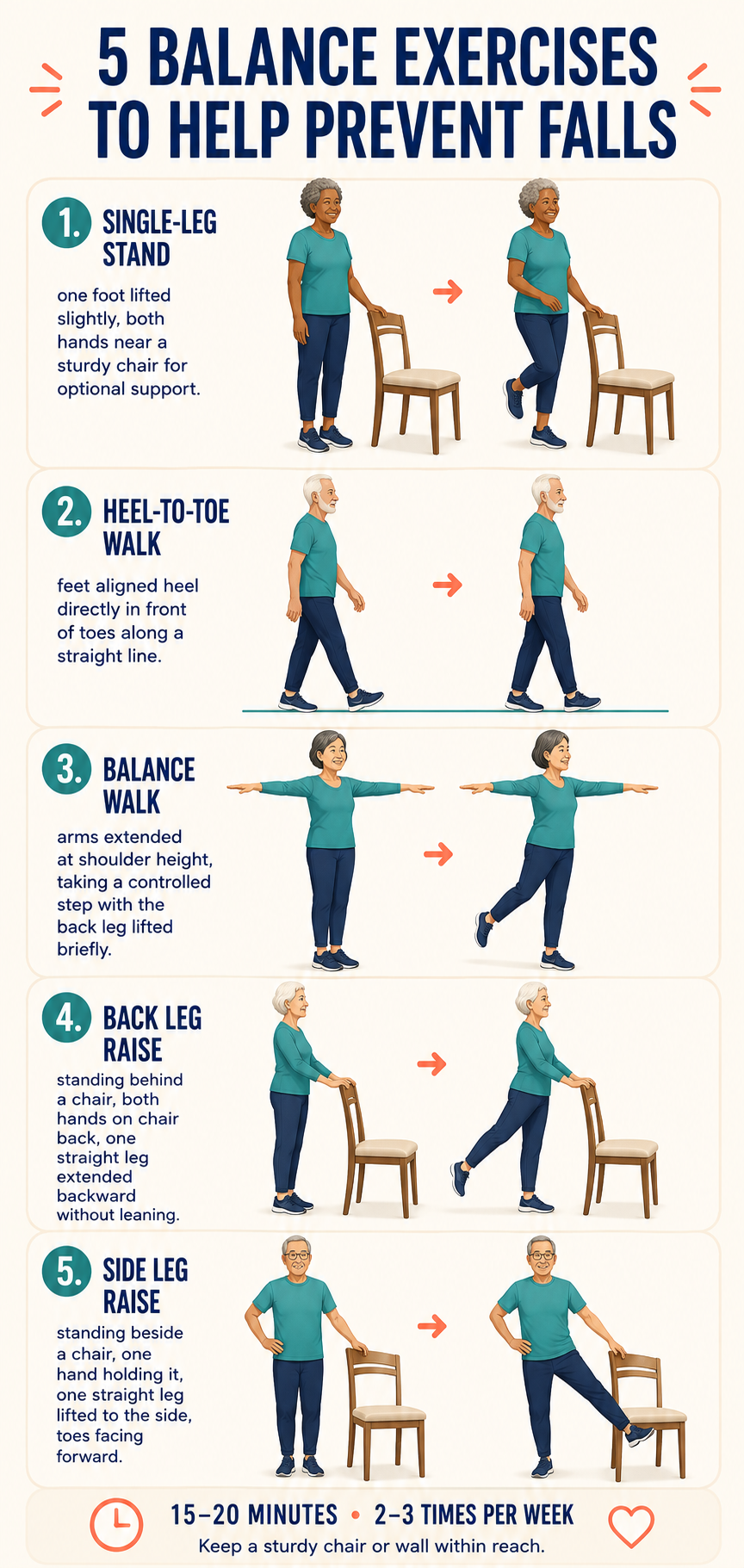
This routine is drawn from balance exercises recommended by the National Institutes of Health and reinforced by clinical guidance from the Cleveland Clinic. All you need is a sturdy chair.
Do this 2–3 times per week. Always keep a chair or wall within reach until you feel steady.
1. Standing on One Foot
Stand behind a sturdy chair, holding on for support. Lift one foot slightly off the floor and hold for up to 10 seconds. Lower and switch legs.
- Reps: 10–15 times per leg, for 3 sets
- Progress by: using one hand, then one finger, then no hands on the chair as you improve
2. Walking Heel to Toe
Position one foot directly in front of the other so the heel nearly touches the opposite toes. Focus on a fixed point ahead of you and walk forward in a straight line, placing heel-to-toe with each step.
- Reps: 20 steps
- Progress by: trying it with your eyes closed once you’re steady (only with a wall or support nearby)
3. Balance Walk
Raise your arms out to shoulder height. Walk in a straight line, and as you take each step, lift your back leg and pause for 1 second before bringing it forward.
- Reps: 20 steps total, alternating legs
4. Back Leg Raises
Stand behind a chair, holding on. Keeping your knee straight, lift one leg straight back without leaning forward. Hold for 1 second, then lower slowly.
- Reps: 10–15 times per leg, for 3 sets
5. Side Leg Raises
Stand beside the chair with feet slightly apart. Lift one leg out to the side, keeping your back straight and toes facing forward. Hold for 1 second, then lower slowly.
- Reps: 10–15 times per leg, for 3 sets
A Note on Safety
- Don’t rush — balance training is about control, not speed.
- Keep a chair, countertop, or wall within reach for every exercise until you’re confident.
- Mild muscle soreness is normal; sharp pain is not — stop if you feel it.
- If you have a health condition affecting your joints, heart, or inner ear (vertigo, dizziness), or you’re recovering from a recent fall or surgery, check with your doctor or a physical therapist before starting a new routine. They can also point you toward supervised balance classes (such as Tai Chi), which the same research suggests may help, though the evidence there is still developing.
The Bottom Line
You don’t need special equipment, a gym membership, or hours of free time to meaningfully lower your fall risk. Fifteen to twenty minutes, two or three times a week, focused specifically on balance — not just general activity — is what the largest body of evidence points to as genuinely effective. Start with support, progress at your own pace, and build it into a habit the same way you would brushing your teeth: small, consistent, and easy to stick with.
Sources:
- Cochrane Database of Systematic Reviews — “Exercise for preventing falls in older people living in the community” (108 RCTs, 23,407 participants)
- National Institutes of Health balance exercise guidance
- Cleveland Clinic — “Keeping Steady: Balance Exercises To Improve Stability”
- CDC STEADI (Stopping Elderly Accidents, Deaths & Injuries) initiative